Performance software approaches for Kinetic Architecture:
Programmable Matter Based Solutions
2015, doctoral thesis by Nelson Montas Laracuente
to read the article online click here
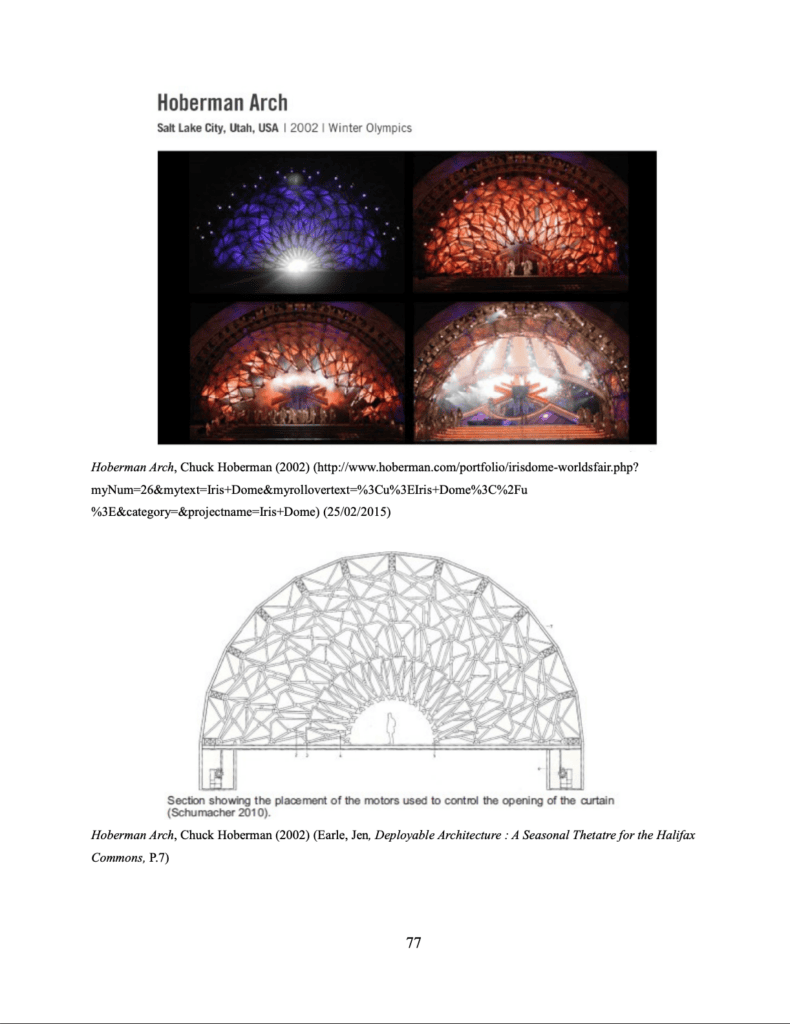
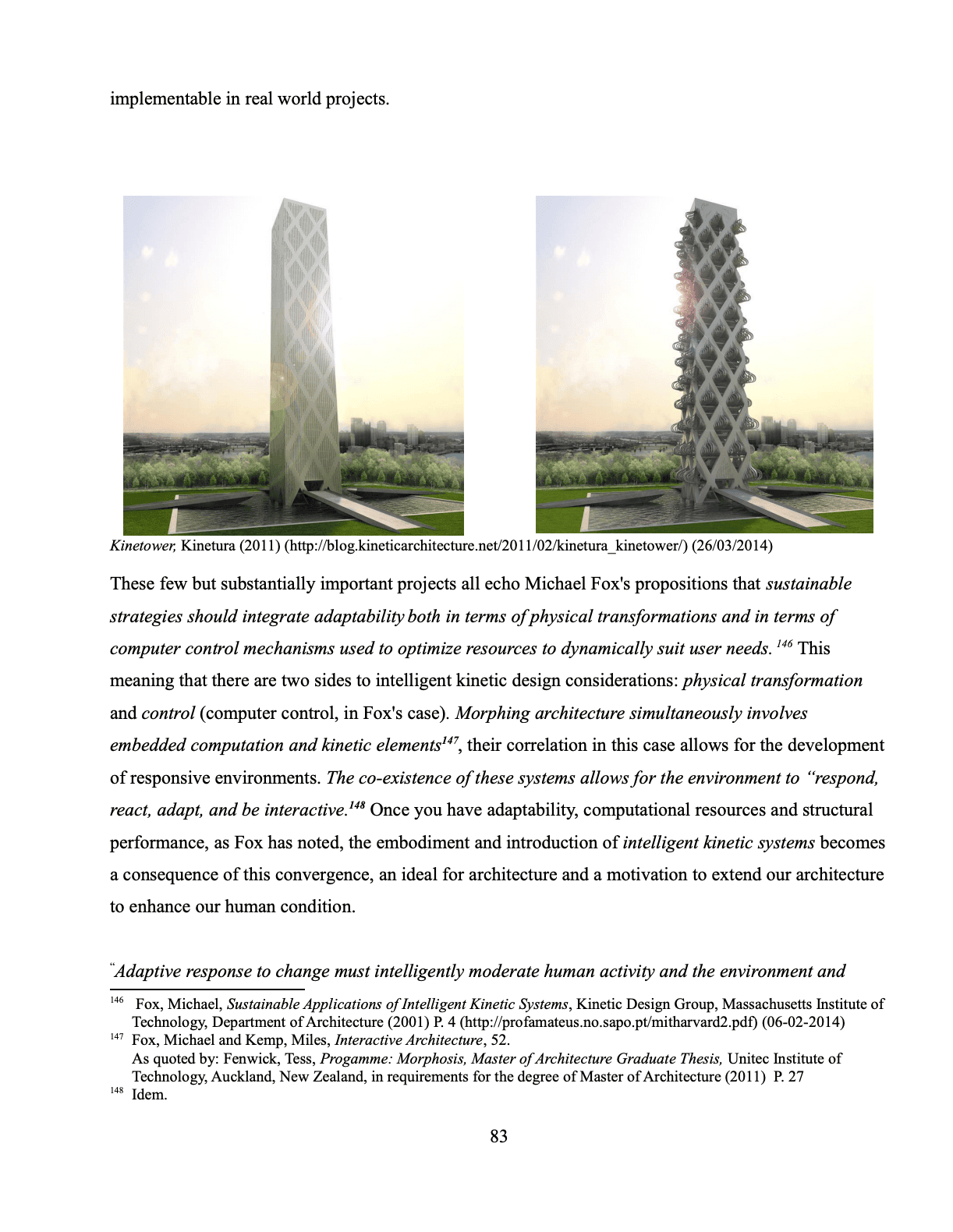
“And meanwhile, insofar as the full building scale is concerned, although not much had been done since Pérez Piñero in the 1960’s (aside from Hobeman’s work); contemporary practice and research is shifting its attention towards kinetics again as in the work of Kinetura (a kinetic design team established in 2006, composed by Barbara van Biervliet and Xaveer Claerhout). They have been successful in proposing a full scale tower building facade in which its elements respond to sunlight and users inside, thus proving empirically that Fox’s remarks are not far fetched and that they are, in fact, implementable in real world projects.
These few but substantially important projects all echo Michael Fox’s propositions that sustainable strategies should integrate adaptability both in terms of physical transformations and in terms of computer control mechanisms used to optimize resources to dynamically suit user needs. 146 This meaning that there are two sides to intelligent kinetic design considerations: physical transformation and control (computer control, in Fox’s case). Morphing architecture simultaneously involves embedded computation and kinetic elements147, their correlation in this case allows for the development of responsive environments. The co-existence of these systems allows for the environment to “respond, react, adapt, and be interactive.148 Once you have adaptability, computational resources and structural performance, as Fox has noted, the embodiment and introduction of intelligent kinetic systems becomes a consequence of this convergence, an ideal for architecture and a motivation to extend our architecture to enhance our human condition.
“Adaptive response to change must intelligently moderate human activity and the environment and build upon the task of enhancing everyday activities by creating architecture that extends our capabilities. Such systems introduce a new approach to architectural design where objects are conventionally static, use is often singular, and responsive adaptability is typically unexplored. Designing such systems is not inventing, but appreciating and marshalling the technology that exists and extrapolating it to suit an architectural vision.”
Contemporary to Fox, Kas Oosterhuis proposes a real-time vision of kinetics in his hyper body paradigm, proposing therefore interactivity, a concept that is slightly out of kinetics scope, which focuses on premeditated repetitive movement, in his kinetic world, things are as bodies (much like kinetic artists of the XX century saw the machine-boy relationship). Movement inspires a new dimension in the way a participant experiences and interacts with a space or building and when done in real-time the experience is the most powerful.150 Adding real time into the kinetic equation gives a game theory flavor to intelligent kinetic design from which, according to Oosterhuis, gives rise to interactive architecture, something that goes beyond merely predicting activities and suiting them in a changeable structure. Exploiting kinetic strategies provides the opportunity to provoke architecture now, and for users and inhabitants to play the buildings ‘game’.151 This denotes an inevitable paradigm shift in architectural design, that is not yet fully here with us but very close to being fruitful and viable. As Michael Fox remarks, it appears that kinetic architecture is not at the beginning, nor is it by any means at the end; but it is, in a sense, at the end of the beginning.”